
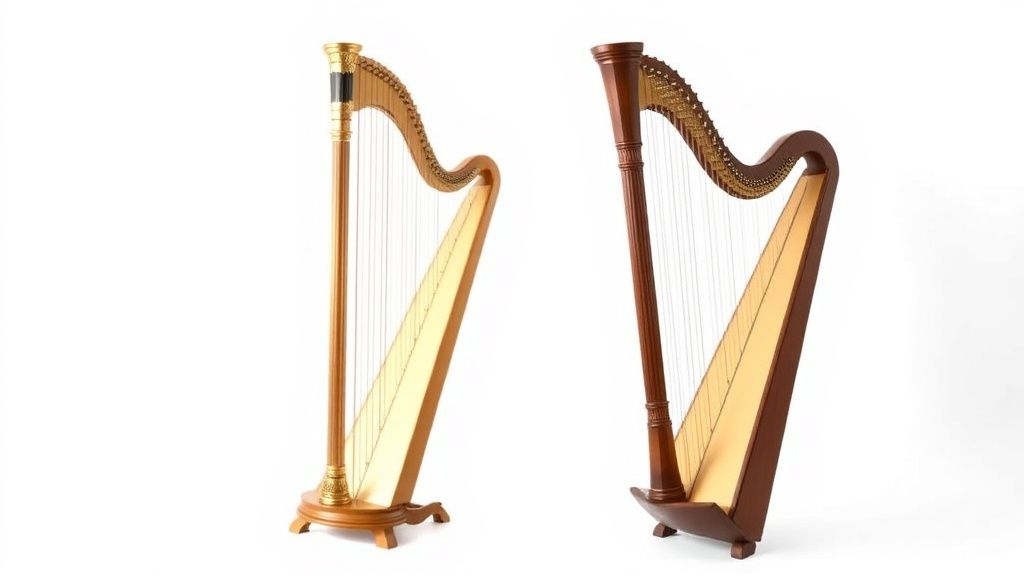
Understanding Harp Pedals: A Comprehensive Guide
Harp pedals are a defining feature of the pedal harp, allowing harpists to change the pitch of the strings and play in different keys seamlessly. Whether you’re a beginner or an experienced player, understanding how harp pedals work and what to look for when evaluating them is essential for making informed decisions about your instrument.
How Harp Pedals Work
Pedal harps typically have seven pedals, each corresponding to a musical note (A, B, C, D, E, F, and G). These pedals are connected to a complex mechanism inside the harp’s body that adjusts the pitch of the strings. Each pedal has three positions:
- Top Position (Flat ♭) – Lowers the string’s pitch by a half step.
- Middle Position (Natural ♮) – The string’s default pitch.
- Bottom Position (Sharp ♯) – Raises the string’s pitch by a half step.
When a pedal is pressed, discs or prongs inside the harp rotate, shortening or lengthening the vibrating length of the strings to alter their pitch. This mechanism allows harpists to play chromatic passages and modulate keys without retuning.
Types of Pedal Mechanisms
Not all pedal harps have the same mechanism. The two most common types are:
1. Single-Action Pedal Harps
- Found on older or student harps.
- Pedals only have two positions: natural and sharp (no flat position).
- Limited to playing in a few keys but simpler to maintain.
2. Double-Action Pedal Harps
- The standard for professional harps.
- Pedals have three positions (flat, natural, sharp).
- Allows full chromatic flexibility and playing in any key.
Most modern pedal harps use double-action mechanisms, though some beginner models may still use single-action for cost and simplicity.
Pedal Ergonomics and Adjustability
Comfort and ease of use are crucial when playing the harp for extended periods. Some features to consider include:
- Pedal Height & Spacing – Pedals should be comfortably reachable without straining the legs. Some harps allow for minor adjustments.
- Pedal Resistance – Some players prefer lighter pedals for faster transitions, while others like more resistance for stability.
- Non-Slip Pedal Covers – Helps prevent feet from slipping, especially during performances.
High-end harps often have finely tuned pedal mechanisms for smooth, silent operation, while budget models may feel stiffer or noisier.
Common Pedal Problems and Maintenance
Like any mechanical system, harp pedals require regular maintenance to function smoothly. Common issues include:
- Sticking or Stiff Pedals – Often caused by dust, humidity, or lack of lubrication. Regular cleaning and professional servicing can help.
- Noisy Pedals – Squeaking or clicking sounds may indicate worn parts or misalignment.
- Loose Pedals – Over time, pedal rods or linkages may loosen, requiring adjustment.
A well-maintained pedal system ensures reliable performance and extends the harp’s lifespan.
What to Look for in a Pedal Harp
When choosing a pedal harp, consider the following factors:
- Pedal Responsiveness – Test the pedals to ensure they move smoothly without excessive noise or resistance.
- Build Quality – Look for durable materials (e.g., brass or steel linkages) that withstand frequent use.
- Adjustability – Some harps allow pedal height or tension customization for player comfort.
- Mechanism Type – Double-action is standard for versatility, but single-action may suit beginners.
- Maintenance Needs – Ask about recommended servicing intervals and ease of access for repairs.
Conclusion
Harp pedals are a marvel of engineering, enabling the instrument’s full expressive potential. Whether you’re purchasing your first pedal harp or upgrading to a professional model, understanding how pedals function and what to look for will help you make the best choice. Regular maintenance ensures smooth operation, allowing you to focus on making beautiful music.
For harpists, the right pedal mechanism can make all the difference in playability and performance—so take the time to test and evaluate before making a decision.
Our picks worth a closer look
- HOW TO PLAY THE LYRE HARP: A Comprehensive Guide To Learning how To Play The LyrCheck on Amazon → — see current price and specs.
- Basic Harp for BeginnersCheck on Amazon → — see current price and specs.
- First Harp Book – Bety Paret | Harp Sheet Music for Beginners | Folk and ClassicCheck on Amazon → — see current price and specs.
- 50 Irish Melodies for All Harps | Harp Sheet Music Songbook for Lever and Pedal Check on Amazon → — see current price and specs.
- 76 Disney Songs for the Harp Arranged by Sylvia Woods | Harp Sheet Music SongbooCheck on Amazon → — see current price and specs.